


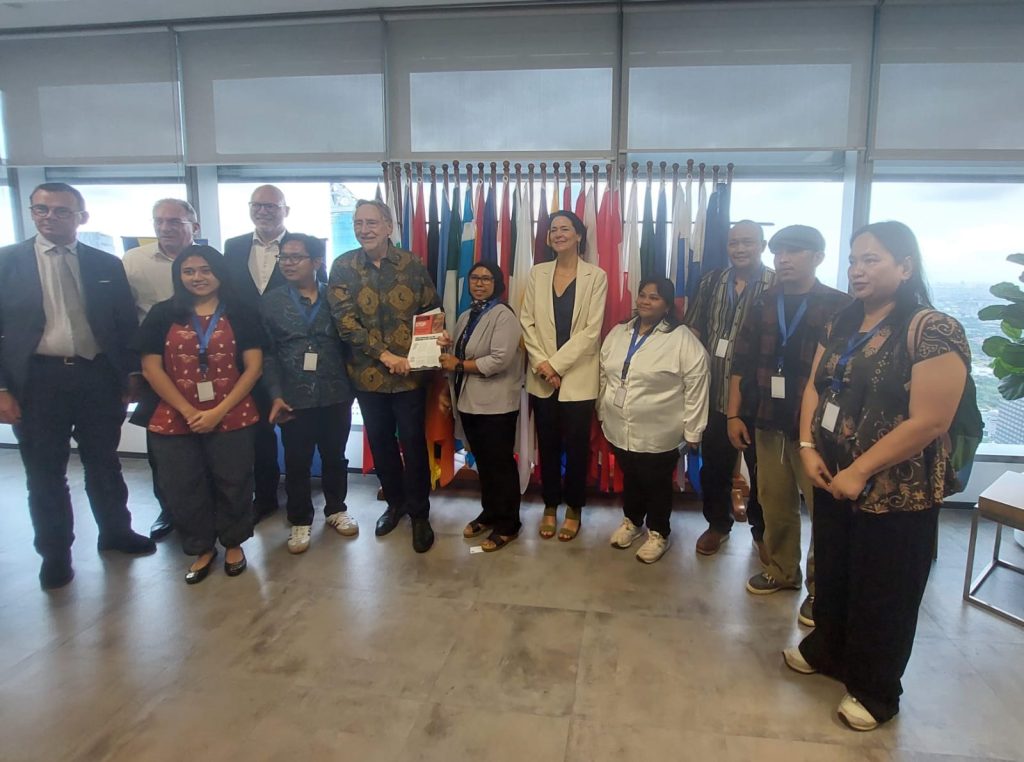
Statement on Raw Materials Issue Rachmi Hertanti and Olisias Gultom
15 April 2025, in Jakarta, Indonesia
The issue of raw materials or critical minerals has become a battleground in world geopolitics today. The agenda to secure mineral supplies in developed industrial countries has driven the implementation of protectionist policies, such as the America First Policy and the EU Green Deal, aimed at strengthening their domestic industries against China’s dominance. These policies only reinforce the colonial role of mineral-rich developing countries as producers of cheap raw materials and consumers of end products from the global north, including locking them permanently at the bottom of the global value chain. Therefore, these conditions have prompted mineral-rich developing countries to become more resilient by moving along value chains and diversifying production that drives economic structural transformation. Added value to critical minerals has emerged as a highly strategic battleground for mineral-rich developing countries.
Increasing demand for critical minerals has triggered overexploitation and extraction of natural resources, particularly in the mineral-rich developing countries. This has two fundamental impacts on these countries, namely: First, the deepening liberalization through trade and investment agreements will only narrow the state’s policy space in defending national policies, create dependence, and hamper the right to development in peripheral countries. Second, the expansion of investments into rich mineral countries have consolidated the role of multinational corporations as key investors and pushing for more investment protections.
In the end, the fundamental question to this battleground is: raw materials for what and whom?
For European Union, free trade agreement with energy and raw material chapter plays a major role to secure EU access to critical raw materials. However, the chapter is negotiated asymmetrically with the global south, especially Indonesia. This chapter seeks to ensure that Indonesia opens market access and eliminates discriminatory treatment in the energy and raw materials sectors. This includes provisions prohibiting export restrictions, including the elimination in principle of all export duties or any measure having an equivalent effect. We also see that the Investment Chapter in EU CEPA will open up more potential investor lawsuits for Indonesia.
For civil society, the policy on export ban of raw minerals is believed to have contributed in reducing the expansion of mining areas and limiting the extraction of mining commodities which have damaged the living space and livelihood of the Indonesian people, especially indigenous peoples, both in Indonesia’s forests, coastal areas, and seas. The ban on raw mineral exports can be a momentum for the Government of Indonesia to control the granting of mining concession permits and the production of mining commodities in a measurable manner so it can be managed responsibly and in harmony with environmental and sustainable planet.
Therefore, on February 18th, the MKE Coalition, together with the European Trade Justice Coalition, issued a joint statement on raw materials in the EU-Indonesia CEPA. We deliver several demands that urge the EU and Indonesian government to ensure the agreement will not pose a threat to the environment and the rights of women, indigenous people, workers, small farmers, and fisherfolks in Indonesia. Indonesia should retain the policy space to develop its own energy and raw materials value chain for the prosperity of its people and not for the profit of the multinational corporations and oligarchs. Finally, both parties should not regulate any investor-to-state dispute settlement mechanism in CEPA where in the end the impact of this mechanism will be jeopardized the people where the state budget potentially harming the subsidies needed for the people in Indonesia.
*****
Main references:
https://europeantradejustice.org/raw-materials-eu-indonesia/
https://www.tni.org/en/publication/the-raw-materials-rush
https://www.tni.org/en/article/between-a-mineral-and-a-hard-place
https://www.tni.org/en/dossier/digging-deeper-conversations
For Further Communication:
Rachmi Hertanti: r.hertanti@tni.org
Olisias Gultom: olisias.gultom@hints.id